




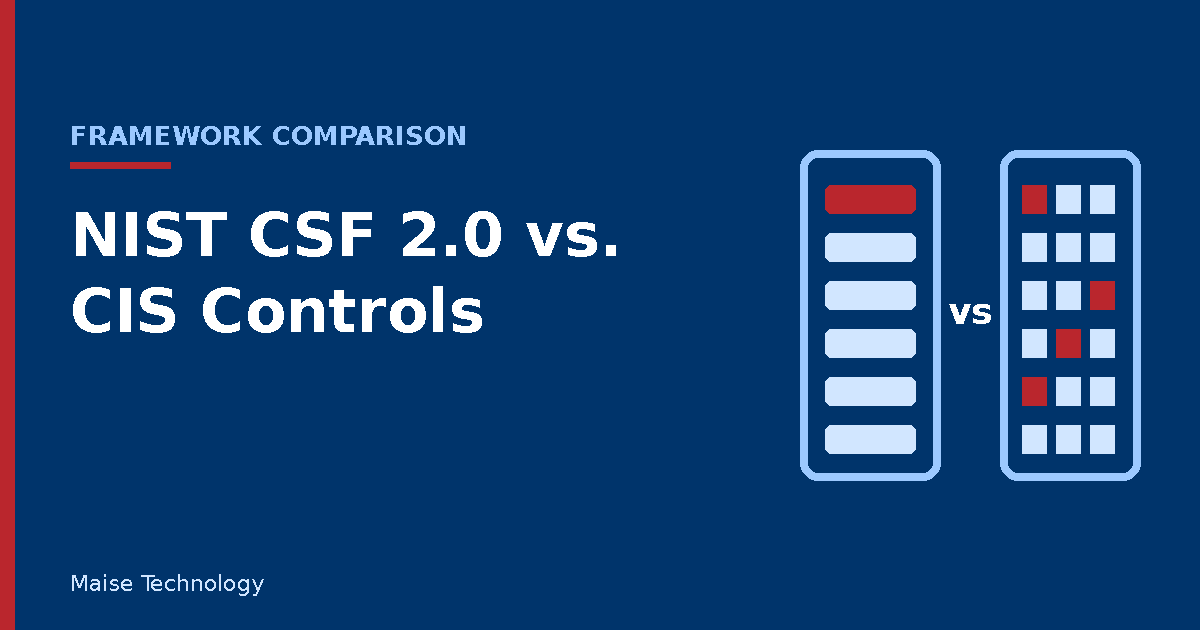
NIST CSF 2.0 and the CIS Controls solve different problems. NIST CSF 2.0 is an outcome-based framework that helps you organize, govern, and report on your whole cybersecurity program, while the CIS Controls are a prioritized list of specific technical safeguards to put in place. For most small and mid-size credit unions, the practical answer is to use NIST CSF 2.0 as the structure and the CIS Controls as the to-do list.
Key Takeaways
- The FFIEC retired its Cybersecurity Assessment Tool (CAT) on August 31, 2025, and pointed institutions toward resources such as NIST CSF 2.0 and CISA's Cybersecurity Performance Goals.
- NIST CSF 2.0 organizes security into six functions: Govern, Identify, Protect, Detect, Respond, and Recover.
- The CIS Controls list 18 Controls and 153 Safeguards, grouped into three Implementation Groups.
- The NCUA continues to offer its Automated Cybersecurity Evaluation Toolbox (ACET) as a voluntary self-assessment.
- Using both together gives your board a clear picture and your IT team a clear plan.
Why Credit Unions Are Picking a New Framework Now
For years, many credit unions measured cybersecurity maturity with the FFIEC CAT. According to OCC Bulletin 2024-25, the FFIEC sunset the CAT on August 31, 2025. Rather than update it, the FFIEC noted that institutions could go directly to newer government resources, including NIST CSF 2.0 and CISA's Cybersecurity Performance Goals.
Credit unions also kept another option. America's Credit Unions reported that the NCUA would continue supporting ACET after the CAT sunset. The NCUA's ACET page describes the tool as completely voluntary and available to institutions of all sizes.
That leaves many boards and managers asking the same question: which framework should we actually build our program around?
What Is NIST CSF 2.0?
The National Institute of Standards and Technology released CSF 2.0 on February 26, 2024. NIST says it is designed for all audiences, industry sectors, and organization types, and it offers quick-start guides for specific users, including small businesses.
CSF 2.0 is organized around six functions:
- Govern: strategy, roles, policy, and oversight. This function is new in version 2.0.
- Identify: understanding your assets, data, and risks.
- Protect: safeguards that prevent or limit incidents.
- Detect: finding attacks and anomalies quickly.
- Respond: acting on a detected incident.
- Recover: restoring operations and services.
CSF describes outcomes, not specific settings. It tells you that you should manage identities and access, for example, but it does not tell you exactly how. That flexibility is its strength for board reporting and its weakness for a small IT team that needs a concrete plan.
What Are the CIS Controls?
The Center for Internet Security publishes the CIS Critical Security Controls. CIS Controls v8 introduced 18 Controls and 153 Safeguards, divided into three Implementation Groups (IGs), and CIS has since released a v8.1 update.
- IG1: 56 Safeguards that CIS calls essential cyber hygiene, aimed at organizations with limited IT and security expertise.
- IG2: adds 74 Safeguards for organizations with more complex environments.
- IG3: adds the final 23 Safeguards for organizations facing sophisticated attacks.
The CIS Controls are prescriptive. They tell you to keep an inventory of devices, configure them securely, use multi-factor authentication, keep audit logs, and so on. That makes them easier to act on, but they say less about governance and board oversight.
NIST CSF vs. CIS Controls: Side-by-Side Comparison
| NIST CSF 2.0 | CIS Controls | |
|---|---|---|
| Type | Outcome-based framework | Prioritized list of technical safeguards |
| Published by | NIST (U.S. Department of Commerce) | Center for Internet Security (nonprofit) |
| Structure | 6 functions, with categories and subcategories | 18 Controls and 153 Safeguards (v8) |
| Level of detail | Describes what to achieve | Describes what to do |
| Governance coverage | Strong, with a dedicated Govern function | Limited |
| Starting point for small teams | Small business quick-start guide | Implementation Group 1 (56 Safeguards) |
| Best for | Board reporting, program structure, risk conversations | Building a technical roadmap and measuring progress |
Where ACET and CISA's Performance Goals Fit
Frameworks and assessment tools are not the same thing. NIST CSF and the CIS Controls describe what a good program looks like. ACET is a self-assessment tool that helps a credit union measure its maturity, and the NCUA notes that it includes tools from CISA, CIS, and NIST. CISA's Cybersecurity Performance Goals are a shorter set of high-impact practices.
Many credit unions can use ACET to measure where they stand, NIST CSF 2.0 to organize the program and report to the board, and the CIS Controls to decide what to fix first. Those choices also feed directly into a written information security plan.
Which Framework Should Your Credit Union Choose?
- Your board needs a clear, high-level view of risk: lead with NIST CSF 2.0. The Govern function maps naturally to board oversight of the information security program.
- You have a small IT team and need a concrete plan: start with CIS Controls IG1. Its 56 Safeguards form a practical baseline.
- You previously relied on the FFIEC CAT: use ACET to keep a familiar maturity measurement, then map gaps to CSF and CIS.
- You are growing or adding digital services: move from IG1 toward IG2 and use CSF profiles to define your target state.
Whichever you choose, start with an honest picture of where you are today. A cybersecurity risk assessment is the natural first step.
Common Mistakes When Adopting a Framework
- Treating the framework as paperwork. A spreadsheet that maps every subcategory but changes nothing on your network does not reduce risk.
- Trying to do everything at once. IG1 exists for a reason. Finish the basics, such as asset inventory, MFA, patching, and tested backups, before chasing advanced controls.
- Leaving the board out. CSF 2.0's Govern function exists because cybersecurity is a leadership responsibility. Share progress in plain language at least annually.
- Ignoring vendors. Core processors, CUSOs, and cloud providers handle much of your member data. Your framework should cover how you oversee them.
- Never re-assessing. Threats and your own systems change. Re-run your assessment on a regular schedule and after major changes.
Talk Through Your Framework Choice With Us
Choosing a framework is easier with someone who has implemented the controls behind it. Book a free initial consultation with Maise Technology to talk through your current program, how it maps to NIST CSF 2.0 and the CIS Controls, and where to focus first. If you would rather start with the details, review our compliance services and our IT support for financial firms.
Frequently Asked Questions
Is NIST CSF 2.0 required for credit unions?
No. NIST CSF 2.0 is a voluntary framework. Credit unions still need an information security program that meets NCUA requirements, and CSF is one common way to structure it.
Can we use NIST CSF and CIS Controls at the same time?
Yes. Many organizations use CSF to organize and report on their program and the CIS Controls to choose specific safeguards. The two are complementary.
What replaced the FFIEC Cybersecurity Assessment Tool?
The FFIEC did not issue a direct replacement. It pointed institutions to resources such as NIST CSF 2.0 and CISA's Cybersecurity Performance Goals, and the NCUA continues to offer ACET.
Where should a small credit union start?
A practical starting point is CIS Controls Implementation Group 1, organized under the six NIST CSF 2.0 functions, with progress measured through ACET or a similar assessment.
Next Step
Not sure which framework fits your credit union? Schedule a free initial consultation and get a clear starting point.
This article reflects publicly available guidance as of its date and is not legal or regulatory advice.